The Last Inch Manifesto: Operational Honesty in Moving and Logistics
Moving companies do not fail because trucks break down or workers call in sick. They fail because of what happens in the final inch of every operational handoff, where verification gets postponed and polite fictions replace operational truth. This manifesto defines the Last Inch Problem, explains why it persists across the industry despite devastating consequences, and presents the systematic solution that makes operational honesty technically mandatory rather than aspirational.
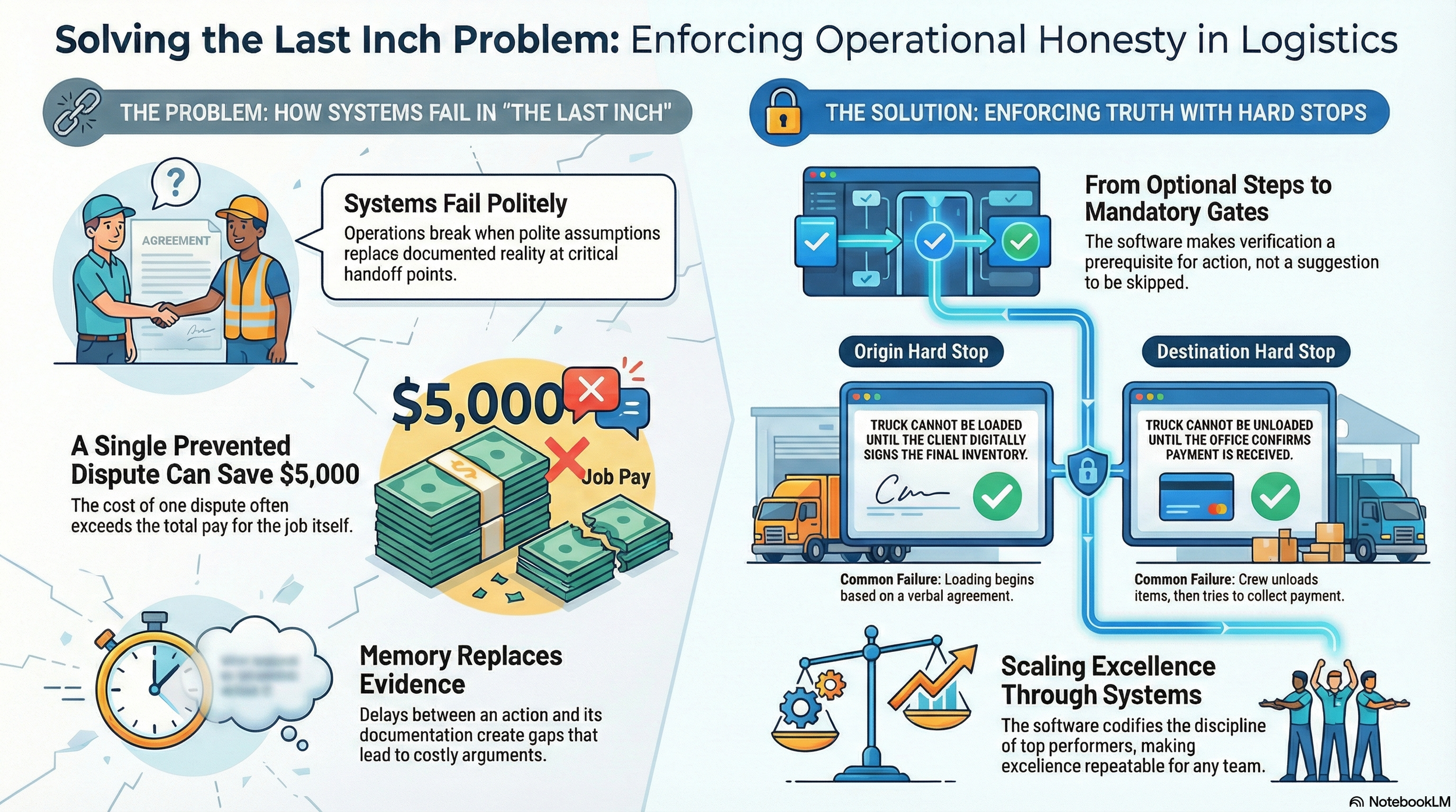
The moving industry operates on a foundational lie that everyone accepts as inevitable: documentation created hours or days after operational events accurately reflects what actually occurred. Drivers complete paperwork from memory after delivering the last load of the day. Office staff estimate inventory details when customers call for quotes without seeing the actual items. Companies bill for services based on projections that may bear little relationship to work actually performed. Customers sign off on deliveries before unpacking reveals damage that occurred during transport but cannot be definitively proven because photographic evidence was never captured at the moment items were loaded.
These polite fictions create the disputes, damage claims, compensation conflicts, and reputation erosion that make moving one of the most complained-about industries in consumer protection databases. The dysfunction persists not because operators lack integrity or customers act in bad faith, but because the operational structure makes verification economically impractical under conventional approaches. Stopping to document everything thoroughly extends job duration, increases labor costs, and creates customer frustration with perceived inefficiency. The economic pressure to move quickly overwhelms the operational discipline required to verify accurately.
The Last Inch Problem manifests at every critical handoff point where responsibility transfers between parties and verification should occur but typically does not. The origin represents the first failure point, where loading begins before customers sign final inventory documenting exactly what condition items presented in before being handled by movers. The transit phase creates the second gap, where items travel from origin to destination without continuous verification that their condition remains unchanged throughout the journey. The destination completes the dysfunction, where unloading occurs before office confirms payment obligations have been satisfied, creating collection challenges when customers dispute charges after possessing their belongings.
These verification gaps create predictable failure patterns that every moving company experiences repeatedly yet treats as isolated incidents rather than systematic dysfunction requiring architectural solutions. Customers claim damage that documentation cannot definitively prove or disprove, leading to disputes where memory conflicts with memory rather than verified facts establishing truth. Operators lose compensation for work actually performed because inadequate documentation prevents proving the scope of services delivered. Companies cannot differentiate quality service from commodity offerings because they lack verified evidence demonstrating their operational excellence to prospective customers evaluating competing providers.
-
JPG Systems develops enforcement technology that makes operational honesty technically mandatory for moving companies committed to systematic excellence. We transform the manual protocols taught in our training programs into automated hard stops that prevent the operational shortcuts and verification gaps that create disputes, damage claims, and reputation erosion.
-
Move Masters OS implements origin and destination hard stops that block critical operations until verification requirements are satisfied, eliminating the gap between documented procedures and actual execution. Real-time evidence capture with GPS coordinates and timestamps creates unchangeable audit trails replacing the polite fictions that emerge when documentation happens after operational events rather than during them.
-
Moving companies committed to operational transparency who recognize that systematic discipline creates competitive advantage through reduced disputes, lower damage claims, premium pricing capability, and customer loyalty. Early adopters willing to participate in beta testing during final development refinement. JPG Method Workshop graduates prepared to implement enforcement technology because their teams already understand the verification protocols the software automates..
The conventional response to these challenges involves exhortations to be more careful, implement better training, or establish clearer policies. These approaches fail because they address symptoms rather than the root cause, which is that the operational structure makes systematic verification economically impractical without technology enforcement. Manual documentation protocols implemented through training and policy inevitably degrade under operational pressure, as the time required for comprehensive verification conflicts with the economic necessity of completing jobs quickly to maintain acceptable profit margins on labor-intensive services.
The solution requires implementing hard stops that make it technically impossible to proceed with critical operations until verification requirements are satisfied. The origin hard stop prevents loading until customers digitally sign final inventory accompanied by comprehensive photographic evidence documenting exact condition of every item at pickup. The destination hard stop blocks unloading until office verification confirms that customer payment obligations have been satisfied in full. Real-time evidence capture throughout the operational process creates tamper-proof audit trail with GPS coordinates and timestamps, eliminating the gap between when events occur and when documentation gets created.
This enforcement architecture transforms operational honesty from aspirational goal requiring voluntary compliance into technically mandatory requirement embedded in the workflow itself. Operators cannot skip verification steps even under time pressure or customer demands because the system physically prevents advancing to subsequent operations until verification completes. The automation eliminates the economic penalty that manual verification protocols impose by reducing documentation time while increasing accuracy and completeness compared to memory-based approaches that introduce errors and omissions creating the disputes the industry currently accepts as inevitable cost of doing business.
The JPG Method codifies the systematic disciplines that create operational honesty into teachable patterns that moving companies can implement immediately through training and organizational commitment. The Move Masters OS software automates these patterns through enforcement technology that makes compliance technically mandatory. Together, they provide the complete solution enabling moving companies to compete on demonstrated operational excellence rather than hoping good intentions produce superior outcomes without systematic verification ensuring that operational reality matches documented claims.